

Imagine being able to find animals only using tiny little particles found in a drop of water. Not being able to see or hear the animal, but knowing for sure it is there because it left traces for you in the water. That is exactly how Patricia Davis (FFN Award winner 2012) is tracking the elusive dugongs in the Arabian Gulf. By searching seawater for environmental DNA, or eDNA, her team is testing a new way to detect one of the ocean’s most elusive marine mammals: the dugong.
Dugongs play hide and seek
Patricia has many years of experience working with this mysterious species, as she started her career studying the most remote population of dugongs in the world. This marine mammal is a true gentle underwater giant, but can be surprisingly hard to find as populations are small and they are able to hide themselves well. Dugongs occur at relatively low densities, spend much of their time underwater and can range over large coastal areas. Researchers usually do aerial or feeding trail surveys to try and find dugongs, but these methods can be both expensive and time-consuming, and may still produce very few sightings.
Tracing dugongs through their DNA
Dugong populations are dwindling worldwide due to coastal development, pollution, climate change, and unsustainable fishing practices. The species has been listed as Vulnerable on the IUCN Red List. In 2012 researchers estimated that about 4,000 dugongs were living in the Red Sea, but their current distribution and status in this region remain poorly understood. Patricia Davis and her research partners therefore set out to find out if they can discover where the dugongs are hiding along the northwestern coast of Saudi Arabia, with the ultimate goal of developing monitoring methods and management strategies.
This is where dugong DNA comes into play. All organisms leave tiny traces of DNA behind wherever they go, through saliva, shedding, faeces or other biological material. This environmental DNA, or eDNA for short, can be collected from water, soil, air or sediment and analysed to identify which species have been present. For rare and difficult-to-see animals, that offers an exciting possibility: rather than finding the animal itself, scientists can look for the genetic traces it leaves behind. Patricia and her colleagues carried out the first ever targeted eDNA survey on dugongs, testing whether seawater samples could reliably detect the presence of dugongs in the northern Red Sea.


The results are in
The researchers collected water samples from four different locations along the northeastern side of the Red Sea. Using eDNA, they were able to confirm the presence of dugongs at half of the sights. This was an encouraging result, as it showed that eDNA can successfully detect dugongs in the marine environment.
But there was also a surprising finding. Evidence from other survey methods showed that dugongs were present at all collection locations, even the two where no dugong DNA was detected. The team even spotted a dugong while they were collecting water samples, but found no dugong DNA in that sample.
While using eDNA seems like a waterproof method, there are strings attached. Environmental DNA does not remain in seawater indefinitely, and can break down in hours or weeks. Temperature, UV radiation and pH can affect how fast DNA is broken down. Together with other biological and sampling techniques, these environmental factors can result in ‘false negatives’, meaning not detecting an animal even though it is there. In short, this means using eDNA can confirm the presence of a species, but cannot confirm the absence of them.
The future of dugong DNA
Population research is ever evolving and there are many ways to improve on how to use eDNA to detect dugongs. For example, dugong specific primers could be developed to ensure the analysis does not mistake dugong DNA for other related species. eDNA could also be taken from sediment around seagrass beds instead of water, as DNA may bind better to organic particles and may be preserved longer.
While using eDNA might have its caveats, the method is significantly cheaper than other options and can be a solution for developing regions. For comparison, the aerial survey that happened at the same time as the eDNA study took 70 hours of flight time over 28 days, giving 50k images, while it only resulted in three confirmed dugong sightings.
A new tool for dugong conservation
Patricia and her colleagues took an important first step towards developing new insights, for science as well as the dugongs. Knowing where dugongs live, and how their distribution changes over time, is essential for their conservation. The study was funded by NEOM a major development initiative in northwestern Saudi Arabia. Dugongs are included within its Marine Species Recovery and Conservation Action Plan, alongside a wider commitment for development to deliver a net-positive environmental outcome.
The study also shows why collaboration between conservationists and major development initiatives can matter. Better information about where vulnerable species occur can help ensure that development decisions take wildlife into account. And sometimes, that information may begin with something as simple as a bottle of seawater.
Updates from the field
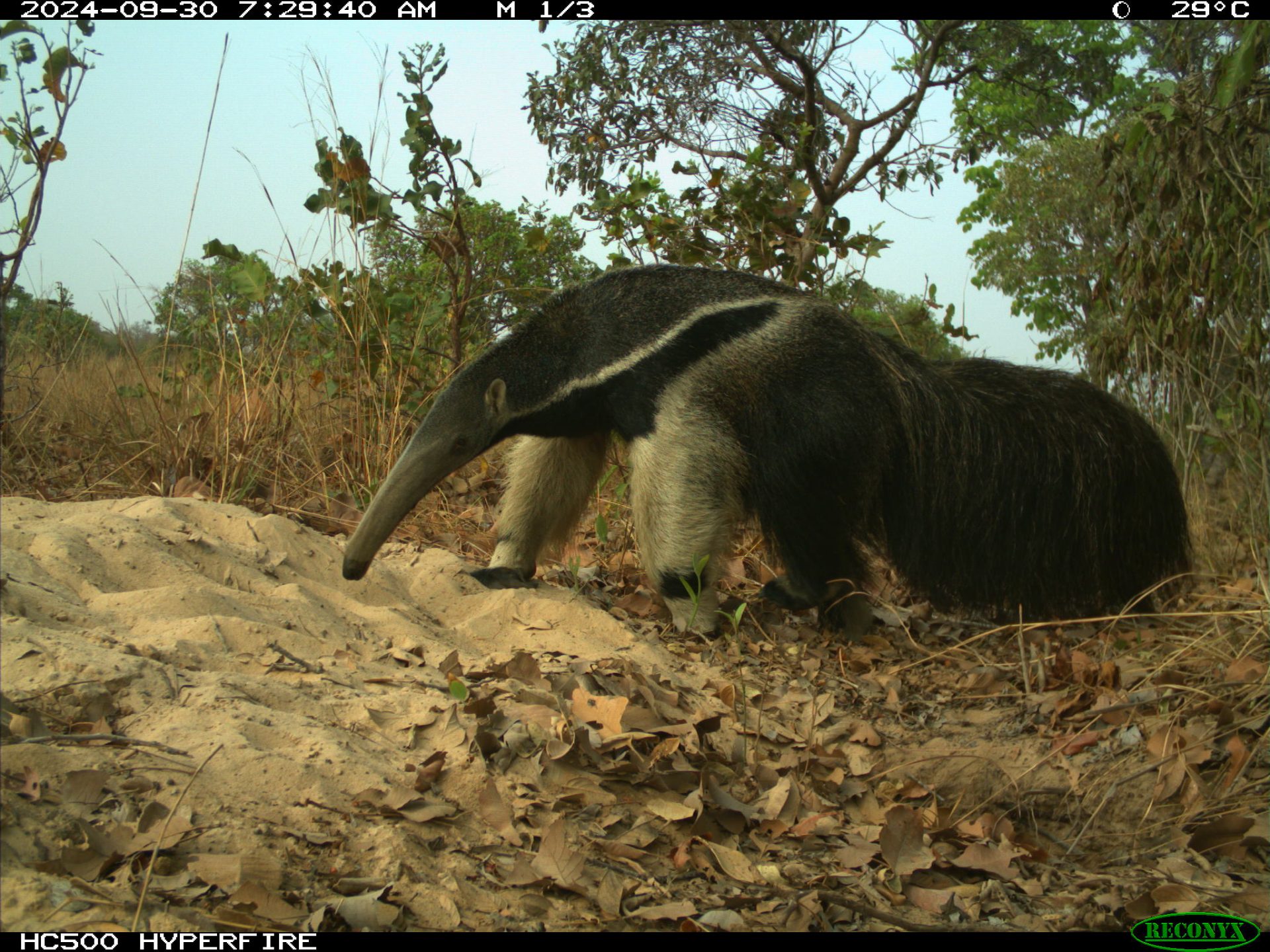
About White Stripes and Dark Bands: Individual Identification of Giant Anteaters
The giant anteater is classified as vulnerable by the IUCN. As with other animal species, identifying free-ranging individuals is crucial for advancing conservation strategies. Gabriel Massocato (FFN Award winner 2022) participated in a…
The Tale of the People of Amedzofe and the Slippery Frog That Didn’t Slip Away
In Amedzofe, Ghana, protecting a critically endangered frog has gone hand in hand with restoring forests, improving livelihoods and creating new opportunities for local people. What began with a species on the brink…


