

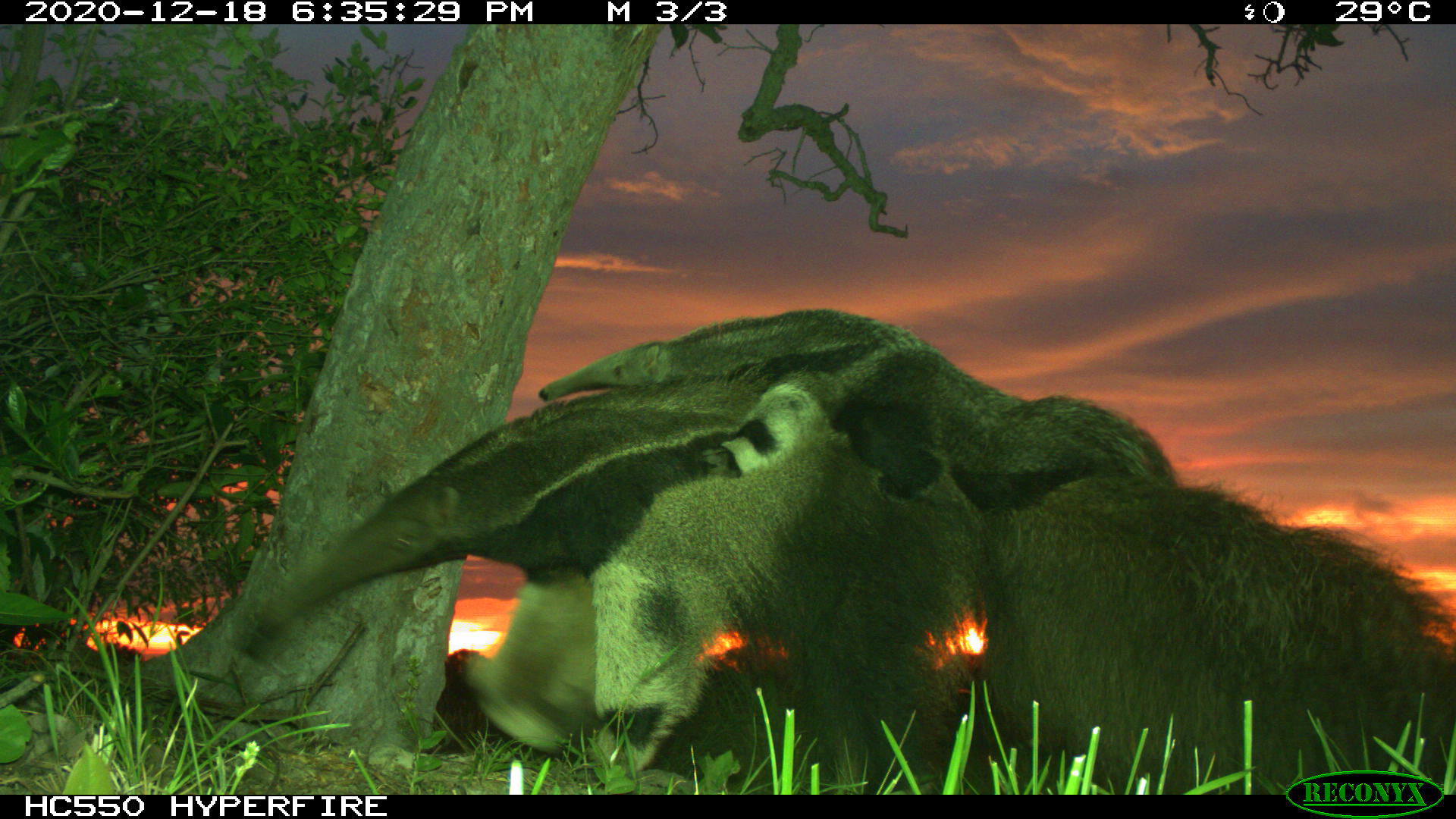
The giant anteater is classified as vulnerable by the IUCN. As with other animal species, identifying free-ranging individuals is crucial for advancing conservation strategies. Gabriel Massocato (FFN Award winner 2022) participated in a research project in Brazil to compile a structured visual catalogue for classifying the variation in pelage patterns among giant anteaters.
Why giant anteaters?
Species with pelage patterns that are not very contrasting or complex are difficult to identify. The giant anteater (Myrmecophaga Tridactyla) is an example of such species. Its unique coat patterns can be used to distinguish individuals from one another. Although previous studies have shown that individual identification based on these patterns is feasible, the variation in these patterns has not yet been systematically described. The study by Gabriel and his colleagues addresses this gap by developing a clear visual reference framework for the pelage patterns of the giant anteater. A structured and well-documented pelage datasets is a critical step toward improving identification practices.
How the research is done
The study utilised camera trap footage from two Brazilian biomes. The first site, located in the Brazilian Pantanal, covered several extensively managed cattle ranches. Records of giant anteaters were obtained between 2011 and 2023 as part of an extensive survey and long-term monitoring of giant armadillos. At the second site, situated at the Santa Bárbara Ecological Station located in the Cerrado, records were taken from March to May 2015.
In the Pantanal study area 246 giant anteater detections were recorded and 307 detections were recorded in the Cerrado. The total of 553 observations were assessed, from which 36 high-quality images were selected on the basis of strict criteria regarding pelage visibility.
The selected images were categorized according to lighting conditions (day or night), animal side (left and right), clarity of markings, and visibility of key identifying patterns. Then the variation in key diagnostic pelage patterns was systematically documented. This includes the upper and lower dorsal white stripes, dark band, elbow, and bracelet, as well as auxiliary patterns such as the wrist, mane, and instep.
The result
The study provides a visual framework for identifying individual giant anteaters based on their pelage patterns. It represents the most comprehensive documentation of these distinctive features to date. The image catalogue, which includes both daylight and infrared images, shows which characteristics vary between individuals. By combining several pelage characteristics, the reliability of individual identification can be improved.
Researchers will find this catalogue a useful practical reference work for identifying free-ranging individuals, as it enables field photographs to be compared against standardised visual criteria. Obtaining high-quality, informative images is particularly difficult when working with camera traps and remote sensing, as environmental factors such as light, viewing angle and movement can affect image quality. Furthermore, this approach requires considerable expertise. For giant anteaters, structured and well-documented datasets can therefore contribute to more consistent identification. The catalogue is intended as a practical reference tool rather than a method for validating identification accuracy.
What it means for the future
Previous studies have shown that pelage patterns can be used for individual identification. This catalogue builds on that work by compiling a larger collection of reference images, which can increase the reliability of identification by researchers. This can benefit ecological research, long-term monitoring, wildlife management and conservation strategies.
The visual catalogue also supports future methodological developments in structured datasets for automated or semi-automated recognition. Pelage pattern catalogues provide a valuable basis for developing and training AI-driven recognition tools, particularly for identifying individual wild animals under challenging field conditions.
Gabriel Massocato and his fellow researchers demonstrate how valuable structured visual catalogues are for studying and identifying individual giant anteaters. This offers promising prospects for the future, as their approach may also be applicable to other animal species with complex or low-contrast coat patterns.
Updates from the field

Just Floating Around: the Dugong and Their DNA
Patricia Davis and her team are testing environmental DNA (eDNA) as a new way to detect elusive dugongs in the Red Sea. Their study confirmed dugong DNA at two of four sampling sites,…
The Tale of the People of Amedzofe and the Slippery Frog That Didn’t Slip Away
In Amedzofe, Ghana, protecting a critically endangered frog has gone hand in hand with restoring forests, improving livelihoods and creating new opportunities for local people. What began with a species on the brink…


